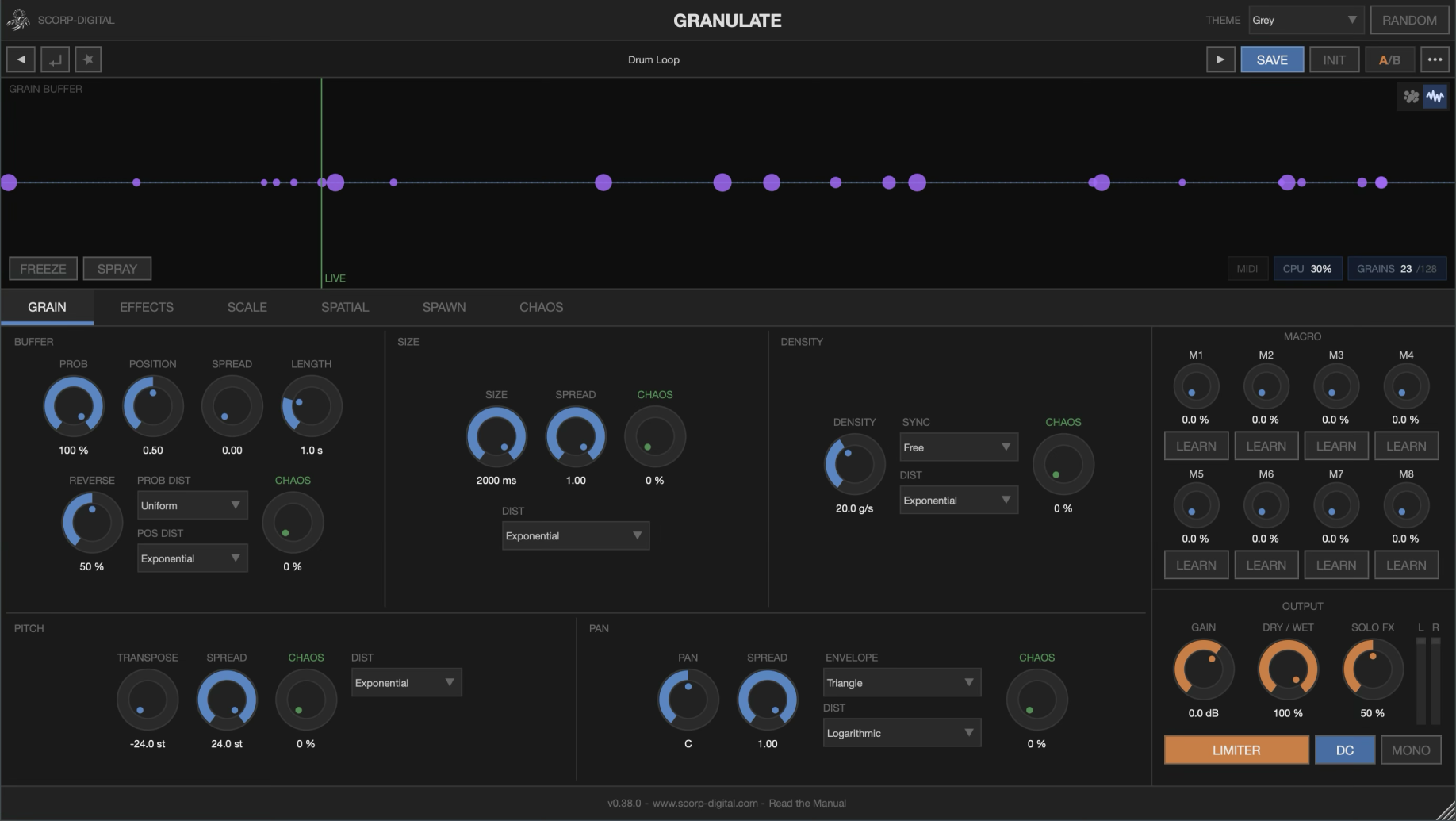
Granulate granular multi-effects VST3 plugin, main interface

Granulate: Granular Multi-Effects VST3 Plugin

v0.38.0 · Beta
VST3 / AU / Standalone · Windows & macOS · 128 voices

Real-time per-grain granular multi-effects processor. Each grain receives its own chain of 16 effects, triggered probabilistically, so no two grains come out identical. Modulation comes from 34 chaotic attractors.

Explore the interface Coming soon

VST3 / AU / Standalone · Windows & macOS · Currently in closed beta, signups closed for now

No connection required
License checks online when available, runs fully offline
2 installs
Per license
Lifetime updates
Free forever
No subscription
One-time payment
Direct support
contact@scorp-digital.com
0
per-grain effects

Every grain carries a full effect chain of its own, triggered probabilistically.

0
CHAOS attractors

6 mathematical families (Lorenz, Rössler, Logistic, D.Pendulum, Clifford, P.de Jong) modulating 28 parameters.

0
stochastic distributions

Every random parameter (size, pitch, pan, density, position, prob) draws from one of 10 statistical laws: Uniform, Gaussian, Exponential, Beta, Arcsine, Logarithmic, Inverse Exp, Cauchy, Binary, Stepped. Keep the same range, switch the law, and the texture changes completely.

0
SPAWN mechanisms

Chord, Granular Delay, Unison, Buffer Scan, Euclidean Rhythm, Grain Step Sequencer. Each grain can spawn others in cascading chains.

0
Grain Voices

128 simultaneous grain voices by default (raisable to 256 in one click), each with its own independent effect chain. Massive textures without polyphony limits.

0
Macros

8 assignable macro knobs (M1–M8). One knob can drive several parameters at once, each with its own amount. Modulation is additive and the assignments are stored in the preset.

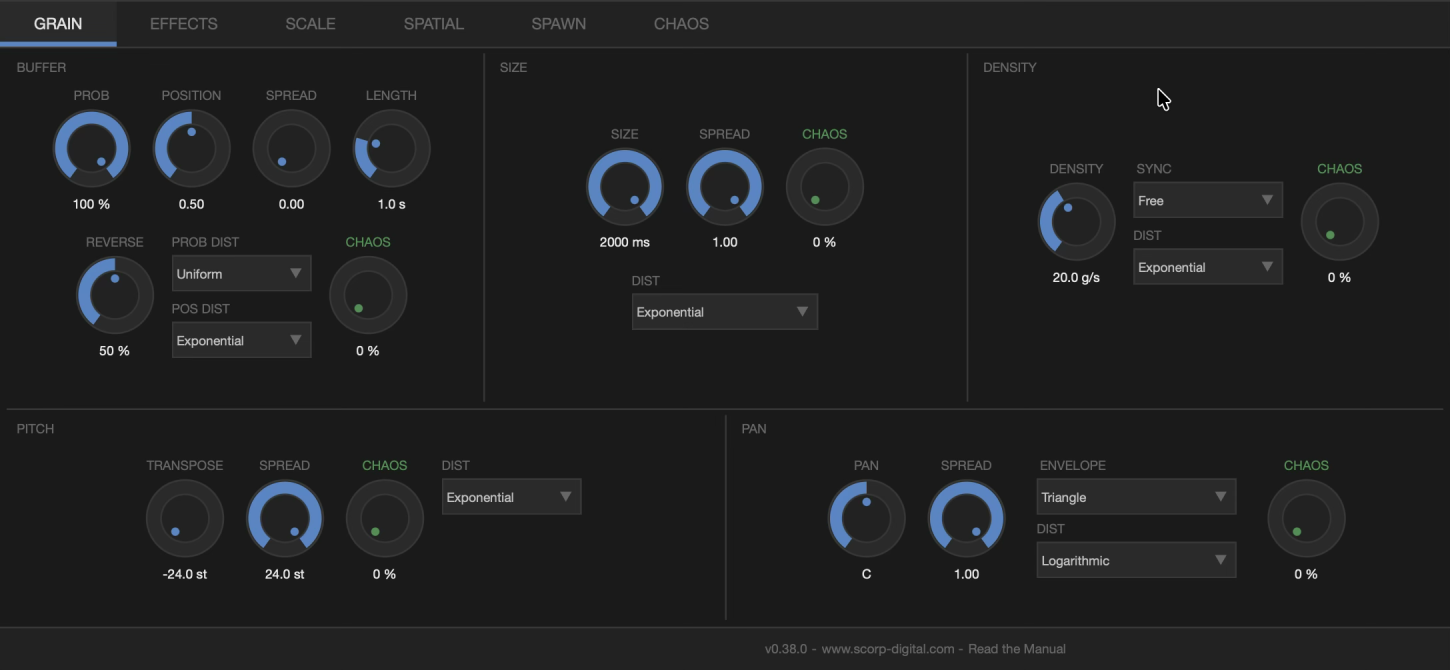
Granulate GRAIN tab, granular synthesizer VST engine controls
GRAIN tab screenshot
The grain engine

The core of the granulator: circular buffer (0.1–30 s), FREEZE, and the 5 dimensions of each grain.

  • BUFFER / FREEZE: Circular buffer 0.1–30 s. FREEZE locks the buffer at a precise instant; grains loop indefinitely inside that frozen fragment without any new signal "polluting" the texture.
  • SIZE: Grain duration + RAND spread per grain. <30 ms = atomised texture; 50–200 ms = classic granulation; >500 ms = near-sample playback with smooth envelope.
  • DENSITY: Grains per second. Simultaneous active voices ≈ DENSITY × SIZE(s). 20 grains/s at 200 ms = ~4 simultaneous; 50 grains/s at 500 ms = ~25 (CPU-intensive).
  • POSITION: Read offset in the buffer (0 = oldest, 1 = most recent). RAND = key to texture richness; without it all grains read the same instant. SCAN = automatic scrubbing.
  • PITCH: Per-grain transposition (±24 semitones) + RAND + CHAOS. Pitch is a playback speed ratio, so timbre shifts along with it, like a tape machine.
  • PAN: Per-grain panning + RAND. High RAND = wide, organic stereo image; each grain born at a different position in the field.
  • ENV: Grain envelope, with 11 shapes to pick from: Hann (cosine, overlap-add at 50% = unity gain, default), Trapeze (flat sustain, stutter textures), Triangle (more aggressive transients), Gaussian (smoothest, no hard edges), Perc & Rise (percussive/plucked attack-decay or reverse-swell), Rect (no shaping, harsh hard digital character), Saw Up/Down, Double Hump, and Random (draws a shape per grain).
  • Stochastic distributions (DIST): Every random parameter (SIZE, DENSITY, POSITION, PITCH, PAN, PROB) has a DIST selector controlling the shape of its random draw, in 10 modes: Uniform (evenly spread), Gaussian (centered, most organic), Exponential (fast decay from minimum), Beta (bounded bell, no extreme values), Arcsine (bimodal: values cluster at both extremes, creating two "populations" of grains), Logarithmic (dense near minimum, rare large deviations), Inverse Exp (mirror of Exponential, dense near maximum), Cauchy (centered with occasional wild outliers), Binary (pure coin-flip, only the two extremes), Stepped (quantized to 5 discrete levels). Same RAND value, radically different textures.
  • SPRAY: When active, each grain's start position is drawn randomly across the entire buffer, ignoring POS and RAND. Maximum buffer exploration: each grain reads a completely different moment.
  • REVERSE PROB: Per-grain probability of reading the buffer backwards. At 0.5, half the grains play in reverse → ghostly, time-reversed texture mixed with forward playback.
  • DENSITY BPM Sync: DENSITY can be locked to DAW tempo via subdivision (Free / 1/1 / 1/2 / 1/4 / 1/8 / 1/16 / 1/32), turning Granulate into a rhythmic granular processor.
  • Grain Scope: The scope offers two views, toggled at the top: CLOUD (each dot = one active grain, with X = pan, Y = pitch, size = amplitude, color = last effect applied) and WAVE (the buffer's own waveform, mono L+R/2, with each grain's live read position drawn on it, colored by dominant FX and dispersed vertically by pitch so low and high grains stay distinct; drag on it while FREEZE is active to scrub the read position of upcoming grains). In both views, a grain whose envelope has ended but whose REVERB / DELAY / RESONATOR tail is still ringing is drawn as a hollow, fading ring instead of a filled dot, its opacity decreasing as the tail dies out. Click the GRAINS N/128 badge to toggle the grain pool cap between 128 and 256 voices; the scope border turns red above 90% of the current cap. CPU XX% badge shows audio thread load and flashes red above 75%.
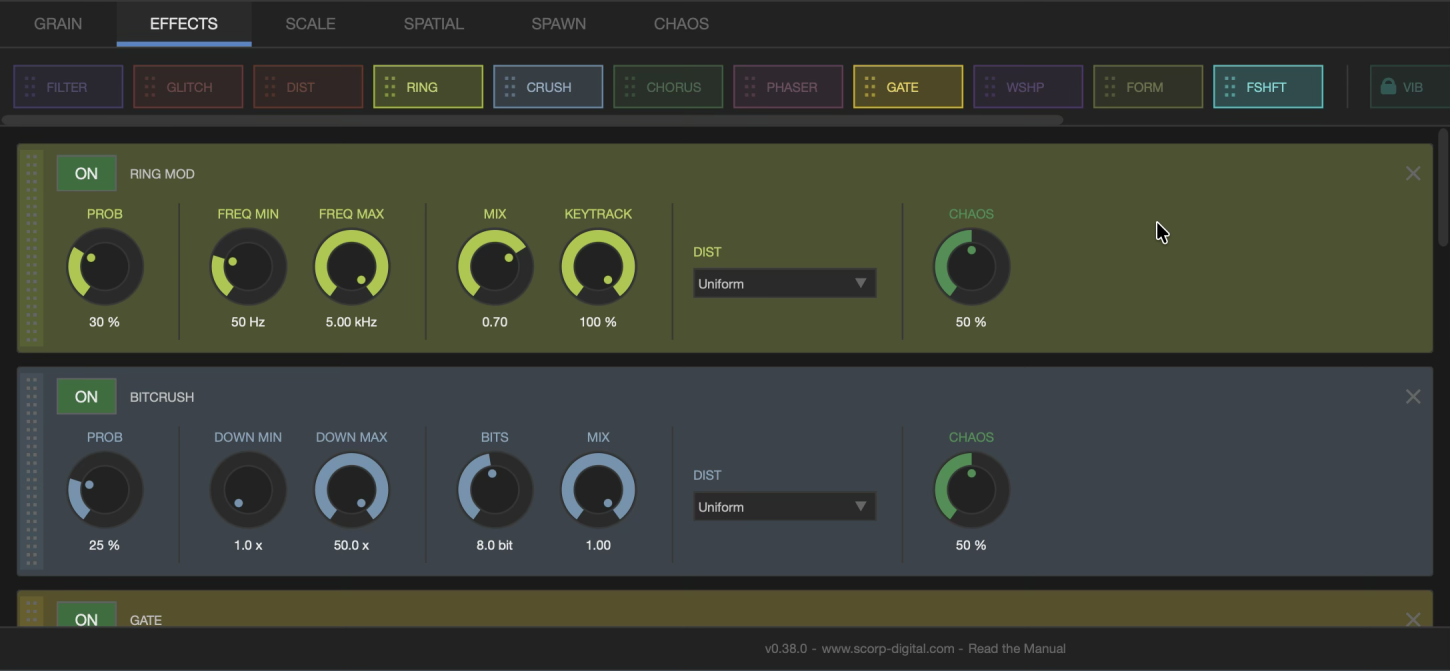
Granulate EFFECTS tab, 16 per-grain effects VST plugin
EFFECTS tab screenshot
Every grain carries its own FX chain

128 DSP instances per effect, pre-allocated at startup. Each grain claims its own instance for its lifetime, so there is no shared bus and no bleed between grains. Drag-and-drop reorderable chain. Each effect has a PROB knob giving its probability of being applied per grain (0 = never, 1 = always).

FILTER GLITCH DISTO RING CRUSH CHORUS PHASER GATE WAVE FORMANT FREQ SHIFT VIBRATO STRETCH ×1000 REVERB DELAY RESONATOR

REVERB, DELAY and RESONATOR are tail effects: they fire after the grain envelope ends. VIBRATO operates outside the serial chain (always applied regardless of position). STRETCH replaces buffer playback with FFT resynthesis.

PROB DIST: Each effect also has a DIST selector applied to its PROB draw (same 10 distributions as the GRAIN tab). In Uniform mode, each grain has exactly PROB% chance of triggering the effect. In Gaussian mode, draws cluster around PROB, so consecutive "bursts" of the same effect become more likely. In Arcsine mode, effects apply in blocks (many active grains in a row, then silence) rather than grain-by-grain. The PROB value never moves; only the rhythmic character does.

  • FILTER: Resonant SVF TPT multimode filter (LP / HP / BP / Notch) per grain. CUTOFF MIN/MAX = random cutoff range per grain. KEYTRACK = cutoff follows grain pitch. RES + CHAOS modulation.
  • GLITCH: Stutter effect that slices the grain into short repeated fragments. SLICE MIN/MAX = random slice duration per grain. REPEATS = number of repetitions per slice. MIX wet/dry.
  • DISTO: Waveshaping saturation. DRIVE MIN/MAX = random drive per grain. TONE = post-distortion filter (0 = dark, 1 = bright). MIX wet/dry.
  • RING: Ring modulation, output = grain(t) × sin(2π × freq × t). FREQ MIN/MAX = random carrier per grain. KEYTRACK = carrier tracks grain pitch. Destroys harmonic ratios → metallic, inharmonic timbres.
  • CRUSH: Bit depth (1–16 bits) + sample-rate decimation per grain. RATE MIN/MAX = random decimation per grain. 8 bits = nostalgic; 4 bits / RATE 4 = heavily degraded grains among clean ones.
  • GATE: Amplitude chopper / tremolo per grain, not a threshold gate. RATE MIN/MAX = random LFO frequency per grain. DEPTH = modulation depth (0 = subtle tremolo, 1 = full on/off chopping). PATTERN = Sine / Triangle / Square / Ramp Dn / Ramp Up / Random LFO shape. SUBDIV = BPM sync subdivision (Free / 1/4 / 1/8 / 1/16 / 1/32 / 1/8T / 1/4T). PROB at 0.4–0.6 = some grains chop while others pass clean → rhythmic texture within the granular flow.
  • WAVE: Waveshaper built on 6 transfer curves: Tanh (smooth symmetric saturation), Sine Fold (bright fold), Hard Clip (rectangular), Cheby (Chebyshev polynomial, even+odd harmonics), Bump (gaussian mid-range), Asym (asymmetric saturation). DRIVE MIN/MAX + BIAS (DC offset before shaping → even harmonics).
  • FORMANT: Laguerre all-pass warping. Shifts formants independently of pitch. SHIFT MIN/MAX λ ±0.6 = random formant position per grain. λ > 0 = brighter; λ < 0 = darker. STAGES 4–12 + RESO for resonant effect.
  • FREQ SHIFT: SSB (Single Sideband) via IIR Hilbert transform (4+4 all-pass stages). Shifts all frequencies by a fixed Hz value, so unlike pitch shift it destroys harmonic ratios. SHIFT MIN/MAX ±5000 Hz. Upper / Lower / Both sidebands. ±5–20 Hz = metallic chorus; ±500–2000 Hz = sci-fi.
  • STRETCH: Spectral resynthesis per grain, running in one of 3 modes: Paul Stretch (pitch-preserving spectral stretch ×1–1000, the classic "infinite space" mode), Spectral Blur (random-phase smear that dissolves harmonic structure into a spectral cloud), Time Loop (cyclic pitched loop with crossfade, the grain looping on itself at target pitch). FFT 256 / 512 / 1024. PITCH FOLLOW (0–100%) sets how much stretched grains follow the grain pitch spread. SHIMMER randomises phases each hop (0.3–0.6 = spectral halo; 1.0 = full cloud). DECAY attenuates magnitudes per hop.
  • FX chain order matters: CRUSH → FILTER (filters harsh harmonics of the crush) vs FILTER → CRUSH (crushes the already-filtered signal) produce radically different characters from the very same settings.
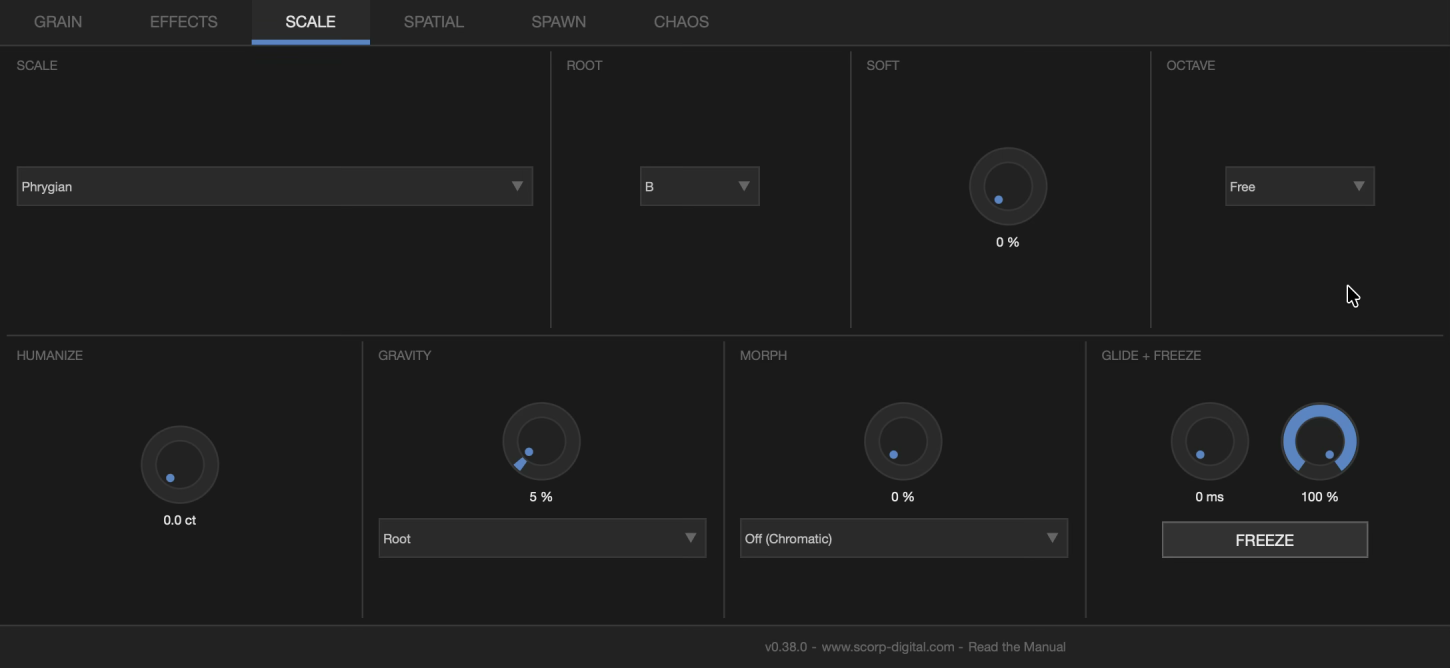
Granulate SCALE tab, harmonic intelligence granular VST
SCALE tab screenshot
SCALE: Harmonic intelligence, per grain

Per-grain modal quantization. Random grain pitches are pulled toward the degrees of a scale, which keeps the texture musically coherent.

  • SCALE / ROOT / OCTAVE: Off (Chromatic) bypass plus 21 scales covering Major, the three Minor scales, Pentatonic Major/Minor, the church modes (Dorian → Locrian), Blues, Whole Tone, Diminished, and a world & microtonal set (Hijaz, Raga Bhairav, Pelog, Slendro, Maqam Rast, Bohlen-Pierce and Quarter Tones), over all 12 roots. OCTAVE clamps quantized pitches to ±1/±2/±3 octaves (or Free).
  • SOFT: Quantization probability per grain (0 = strict, 1 = bypass). 0.7–0.85 = musical result that floats slightly around the scale, often more musical than 100% quantization.
  • PITCH FREEZE: Freezes grain pitches independently of the buffer. All other parameters (position, size, density, effects) continue to evolve while the harmonic context stays locked.
  • HUMANIZE: Micro-pitch variations (Gaussian, in cents) that simulate human playing. The texture "breathes." Modulated by an assignable CHAOS attractor for aperiodic variation.
  • GRAVITY: Magnetic attraction force toward specific scale degrees, without hard quantization. GRAVITY DEG selects the target: Root / 5th / Root+5th / Triad. Shares its CHAOS attractor with GRAIN PITCH (marked * in CHAOS tab).
  • SCALE MORPH: Progressive interpolation between two scales. Both scales' degrees coexist with variable probability at intermediate values. Shares CHAOS attractor with GRAIN PAN.
  • GLIDE: Portamento between consecutive grains (RATE + PROB). PROB = 0.4 → some grains slide, others don't → spontaneous legatos in the texture.
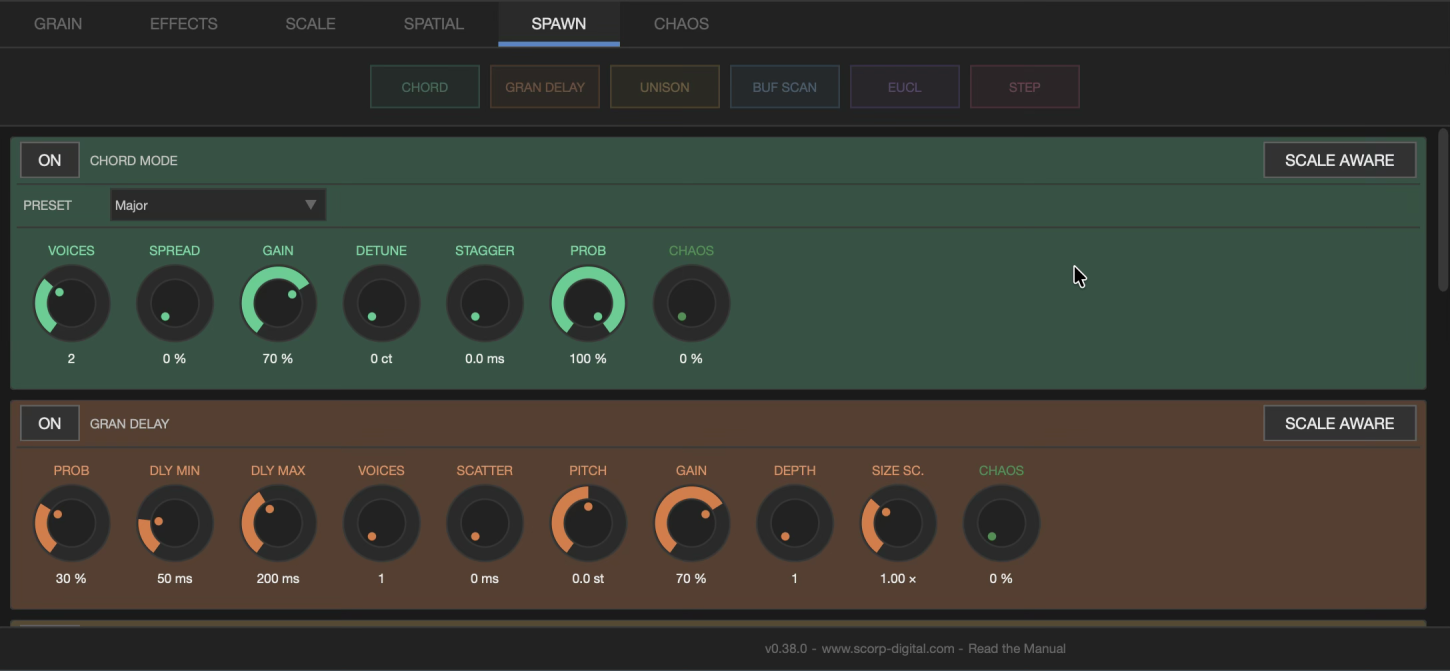
Granulate SPAWN tab, cascading grain generation VST plugin
SPAWN tab screenshot
One grain becomes many

6 mechanisms let each grain spawn others: as chords, echoes, detuned copies, alternate scans, euclidean rhythms, or pitched step sequences.

  • CHORD: 14 chord presets (including a free Custom mode with per-semitone sliders). STAGGER (ms) = granular arpeggio instead of a block chord. SPREAD = stereo spread across voices. DETUNE (cents) = analog imperfection. SCALE AWARE = forces chord notes into the active SCALE.
    Octave +12 Power +7 Major +4+7 Minor +3+7 Maj7 +4+7+11 Min7 +3+7+10 Dom7 +4+7+10 Sus4 +5+7 Add9 +4+7+14 Stack 5ths +7+14 Stack 4ths +5+10 Cluster +1+2 Wide +12+19+24 Custom
  • GRAN DELAY: Recursive echo grains, where each echo is a full grain that can itself generate echoes. DEPTH = 1–4 generations. VOICES = simultaneous echo voices per generation. PITCH = transposition accumulated per generation (+12 = echoes rising an octave each time). GAIN SCALE = attenuation per generation. SIZE SCALE = grain size ratio per generation. DELAY MIN/MAX + SCATTER control the timing spread.
  • UNISON: 2–8 cloned voices. Voices distributed evenly between −DETUNE/2 and +DETUNE/2 cents. SPREAD = stereo spread across voices. GAIN = level per extra voice. PROB = 0.5 → unison activates on half the grains → alternation between solo and thick grain.
  • BUFFER SCAN: Second grain stream reading the buffer at a configurable speed and direction. MODE: Forward / Backward / Ping-pong / Chaos. RATE (0.01–2 Hz) controls scan speed. DEPTH = fraction of buffer covered.
  • EUCLIDEAN: Bjorklund algorithm. STEPS + HITS + OFFSET + SWING. Classic patterns: (8,3) bossa nova, (8,5) Cuban tumbao, (16,5) medieval, (12,7) Afro-Cuban. Ring visualizer shows hit distribution in real time.
  • GRAIN STEP SEQUENCER: Assigns a pitch offset (±24 semitones) to each grain in a cyclic 1–8 step sequence, layering a repeating melodic pattern over the granular cloud. MODE: Forward / Backward / Ping-pong / Random. SCALE AWARE quantizes step pitches to the active SCALE.
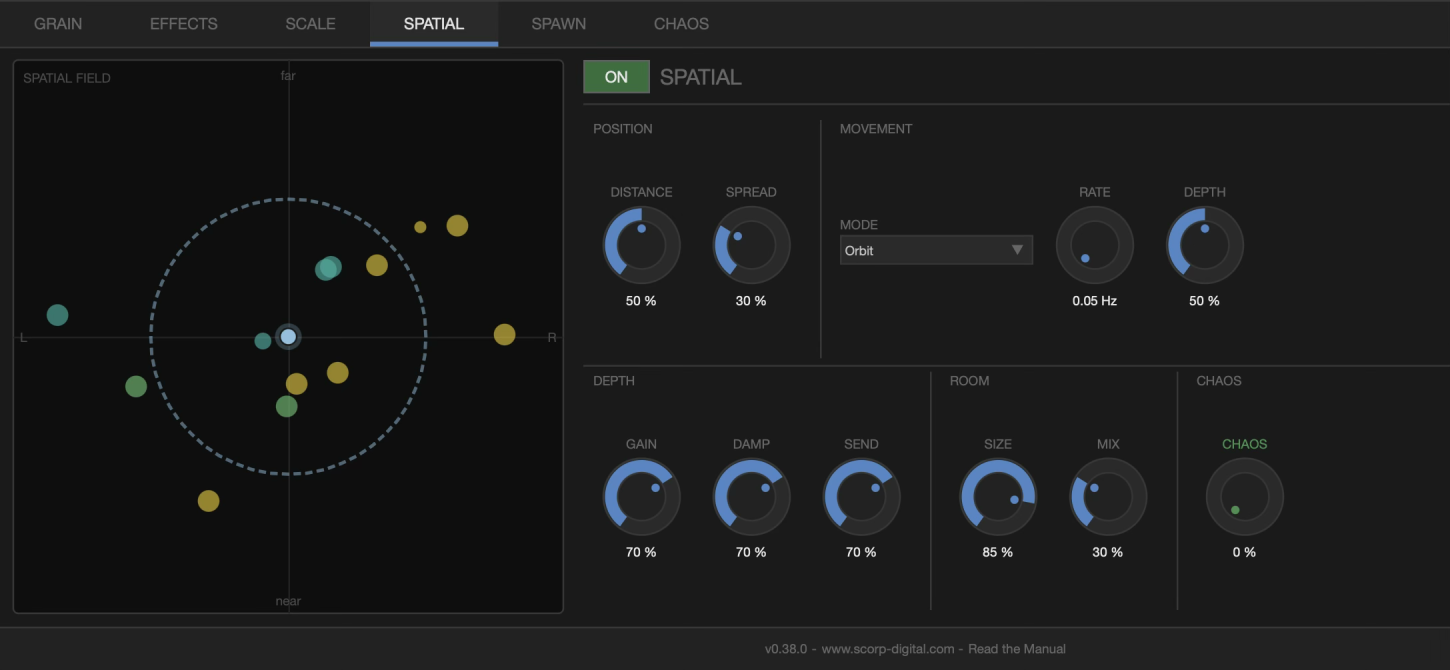
Granulate SPATIAL tab, per-grain spatial audio VST plugin
SPATIAL tab screenshot
Per-grain space

2D positioning of each grain in stereo space. The pad displays all active grains in real time, color-coded by their last applied effect.

  • 2D Pad: X axis = pan, Y axis = distance (near = bottom, far = top). Each dot = one active grain, color-coded by the last effect applied to it. Updated in real time (~30 Hz).
  • Grain color legend: ■ STRETCH · ■ GLITCH · ■ DISTO · ■ WAVE · ■ FORMANT · ■ FREQ SHIFT / CHORUS · ■ PHASER · ■ REVERB · ■ DELAY · ■ RING · ■ CRUSH · ■ RESONATOR · ■ no effect
  • MOVE MODE: Each grain can move autonomously in the stereo field during its lifetime. 6 modes: Static (fixed at birth), Orbit (circular sweep), Spiral (orbit expanding/shrinking over the grain's life), Ping-pong (bounce left-right), Random (random walk), Chaos (Lorenz-driven position). MOVE RATE = speed (Hz), MOVE DEPTH = amplitude (0–1).
  • DIST + CHAOS: Distance automatically modulates 3 parameters: Gain (farther = quieter), HF Damping (farther = duller), Room send (farther = more reverb). DIST SPREAD = per-grain distance randomization. CHAOS attractor makes grains drift organically between near and far.
  • Room Reverb: Global room independent from per-grain REVERB effect. Receives signal proportional to each grain's distance. ROOM (RT60 decay) / MIX (room level). Use at moderate MIX for "glue", and per-grain REVERB for individual expression.
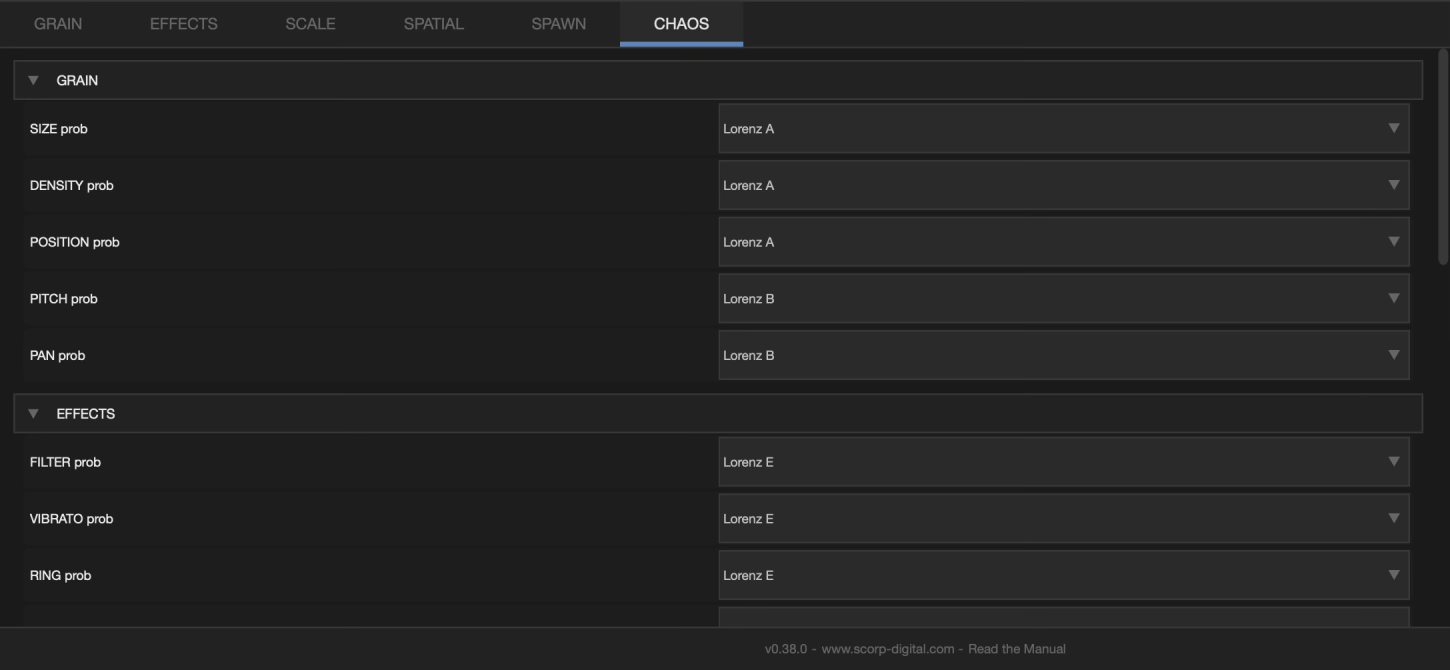
Granulate CHAOS tab, 34 mathematical attractor modulators VST
CHAOS tab screenshot
34 mathematical attractors, all running at once

34 dynamic systems running in parallel, each producing an aperiodic value read at every grain birth. Unlike an LFO: the sequence never repeats.

All 34 attractors run in parallel, advanced together at every grain birth (lock-free read via atomics). Modulation formula: effective = dist_sample × (1 − chaos_amount) + attractor_value × chaos_amount

  • Lorenz A→M (13): General purpose. Continuous aperiodic flow, wide spectral range. Default attractor for most parameters.
  • Rössler 1→4 (4): Slow continuous oscillations. Best for: FILTER CUTOFF, ROOM SEND, slow modulations.
  • Logistic 1→6 (6): Sharp ON/OFF transitions. Best for PROB parameters (REVERB, GLITCH, CHORD), where it creates abrupt activation bursts.
  • D.Pendulum 1→3 (3): Semi-melodic with ruptures. Best for GRAIN PITCH and GRAVITY, chaotic but with melodic structure.
  • Clifford 1→4 (4): Slow, organic movement. Best for PAN, SCALE MORPH and DIST, giving smooth spatial drift over time.
  • P.de Jong 1→4 (4): Irregular density bursts. Best for SPAWN PROB and EUCLIDEAN, for irregular rhythmic activation.
  • 5 collapsible groups: GRAIN (SIZE/DENSITY/POSITION/PITCH/PAN prob), EFFECTS (all 14 selectable FX attractors), SCALE (GRAVITY *, SCALE MORPH *), SPATIAL (DIST chaos), SPAWN (CHORD/GRAN DELAY/UNISON/BUFFER SCAN/EUCLIDEAN prob). Click a group header to expand/collapse.

Attractor sharing: GRAVITY shares its slot with GRAIN PITCH · SCALE MORPH shares its slot with GRAIN PAN. Both are marked * in the CHAOS tab. Changing the shared row modulates the other parameter's chaotic spread; the pitch/scale-switch trigger itself still uses plain randomness.

Evolving frozen drone

FREEZE → SIZE 400 ms / DENSITY 8 / REVERB PROB 0.7 / SCALE Dorian / CHAOS D.Pendulum → static but living texture, harmonically coherent.

Euclidean glitch percussion

GRAIN 30 ms / GLITCH PROB 0.5 / EUCLIDEAN 16 steps 5 hits / GRAN DELAY 2 generations / CHAOS Logistic 6.

Infinite spectral pad

STRETCH ×300 / FFT 1024 / SHIMMER 0.4 / CHORD Maj7 STAGGER 60 ms / SCALE Lydian / SPATIAL ROOM 0.9.

Self-generated melody

DENSITY 6 / PITCH RAND 12 st / SCALE Pentatonic SOFT 0.85 / GLIDE PROB 0.45 / GRAN DELAY PITCH +12 → melodic line with spontaneous portamentos.

Sci-fi texture

FREQ SHIFT ±800 Hz Both / RING PROB 0.3 / PHASER FEEDBACK 0.7 / CHAOS P.de Jong → inharmonic robotic sound, science-fiction type.

Formant bass

FORMANT CHAOS Rössler 1 → continuous formant sweep / WAVE Tanh / SCALE Pentatonic Minor / HUMANIZE 0.25.

Demo

Specifications

Version0.38.0
FormatVST3 / AU / Standalone (macOS) · VST3 / Standalone (Windows)
CompatibilityWindows 10/11 · macOS 10.13+ (High Sierra and above)
Architecture64-bit · Universal Binary (arm64 + x86_64)
Polyphony128 simultaneous grain voices (default) · toggleable to 256 via the GRAINS badge (machine-wide preference)
Per-grain effects16 (11 reorderable series + Vibrato + Stretch + 3 Tail) · 128 DSP instances per effect
Macros8 assignable macro knobs (M1–M8) · multi-parameter routing · LEARN assignment · additive modulation · persisted in presets
Output clusterGAIN · DRY/WET · SOLO FX · LIMITER · Stereo L/R peak meter (clip LED) · DC FILTER · MONO
CHAOS attractors34, across 6 families (Lorenz ×13, Rössler ×4, Logistic ×6, D.Pendulum ×3, Clifford ×4, P.de Jong ×4)
CHAOS modulation targets28 parameters across GRAIN / EFFECTS / SCALE / SPATIAL / SPAWN
Circular buffer0.1 → 30 seconds
Stochastic distributions10 per randomizable parameter: Uniform · Gaussian · Exponential · Beta · Arcsine · Logarithmic · Inverse Exp · Cauchy · Binary · Stepped
Spectral Stretch×1 → ×1000 · Paul X Stretch per-grain · FFT 256 / 512 / 1024
Scales21 (+ Chromatic bypass): Major · Nat./Harm./Mel. Minor · Penta Maj/Min · church modes (Dorian → Locrian) · Blues · Whole Tone · Diminished · Hijaz · Raga Bhairav · Pelog · Slendro · Maqam Rast · Bohlen-Pierce · Quarter Tones · all 12 roots
Chord presets14 (Octave, Power, Major, Minor, Maj7, Min7, Dom7, Sus4, Add9, Stack 5ths, Stack 4ths, Cluster, Wide, Custom)
SPAWN mechanisms6 (Chord, Gran Delay ×4 gen., Unison 2–8 voices, Buffer Scan 4 modes, Euclidean Bjorklund, Grain Step Sequencer 1–8 steps)
CPU · light8 grains/s, no effects: <5%
CPU · moderate20 grains/s, REVERB + STRETCH: ~10–20%
CPU · heavy40 grains/s, STRETCH FFT 1024, UNISON ×4: ~25–50%
Audio threadZero allocation (all DSP instances pre-allocated at startup)
UI sizesSmall 880×496 · Medium 1100×620 · Large 1375×775 · Free resize 60–200%
UI themeGrey · Dark · Light, persists across sessions
Tested DAWsReaper · Ableton Live · Logic Pro · Bitwig Studio · FL Studio
Preset systemPreset Manager · Factory presets · Factory / User folders · Browser with search & favorites · A/B snapshots + ratio slider + MORPH breeding · SAVE / INIT · ◂/▸ navigation · RANDOM + RETURN · FX order, CHAOS assignments & Lock states persisted
ActivationLicense key · checks online when available, runs fully offline · 2 simultaneous installs
RAM4 GB recommended · ~5–10 MB for 128-voice pools
FAQ

How do I get access to Granulate?
Granulate is currently in closed beta and signups are closed for now. Public availability and pricing will be announced on this page when the plugin is ready.
Is there a free trial?
There is no time-limited trial at the moment. If you have questions first (compatibility, a specific use case, anything else), reach out at contact@scorp-digital.com. That mail comes straight to my own inbox. I'll answer within 48 hours.
Does it require an internet connection?
The license is checked online each time Granulate opens, but only when a connection is available. Without one, the plugin still loads and runs at full capability: no feature is restricted and no time limit applies. No telemetry, no call home beyond license checks.
How many computers can I install it on?
Each license covers 2 simultaneous installs (e.g. studio desktop + laptop). If you need to transfer a license to a new machine, contact support and it's handled manually, no questions asked.
Are future updates included?
Yes. Lifetime updates are included, free of charge. Every new version (bug fixes, new features, new CHAOS attractors, new FX) will be delivered free to license holders. No subscription.
Which DAWs are supported?
Granulate has been tested and confirmed working in Reaper, Ableton Live, Logic Pro, Bitwig Studio, and FL Studio. It follows the VST3 and AU standard, so it should work in any compliant host. If you encounter issues in another DAW, report it and it will be investigated.
Which platforms and formats are supported?
Granulate runs on Windows 10/11 (VST3 + Standalone) and macOS 10.13+ (VST3 + AU + Standalone, Universal Binary for Intel & Apple Silicon). The Standalone app runs without a DAW. Both installers are provided. Linux is not supported at this time.

Controls & shortcuts

Turn a knobClick + drag vertical
Precise value entryDouble-click on knob → editable text field
Reset to defaultDouble-click (any knob except PROB)
Reset PROB to 0Double-click on a PROB knob
MousewheelHover over knob or text field + scroll
Lock / Unlock parameterRight-click any control → Lock · persisted in preset
Reorder FX chainDrag the ≡ handle in the FX Flow Bar · drag chip near edge → auto-scrolls
Resize interfaceRight-click the GRANULATE title → Small / Medium / Large
Change UI themeTHEME combo (header) → Grey / Dark / Light
SOLO FXBlend dry ↔ FX-processed grains (0 = only dry grains, 0.5 = both, 1 = only grains with an active effect). Push toward 1 to audition effects in isolation
Collapse CHAOS groupClick on group header
Navigate presets◂ / ▸ buttons in the preset bar
Open Preset BrowserClick the preset name · or ≡ button
Toggle favorite★ button in the preset bar
A/B compareA/B button toggles between two in-memory snapshots (button turns blue on slot B) · ratio slider (double-click = 0.5)
A/B MORPHMORPH button breeds a new LIVE state from A/B weighted by the ratio slider (lerp on continuous params, weighted draw on discrete ones) without touching A or B. Click repeatedly for new variations
Save presetSAVE button → name dialog (illegal characters replaced by _) · saved to User/ folder
Reset to defaultsINIT button resets all parameters, FX order, CHAOS assignments and Euclidean overrides
Randomize unlocked paramsRANDOM button (header) · Fisher-Yates, includes FX order
Undo randomizationRETURN button, one level of undo
Assign a macroClick LEARN on a macro (M1–M8) → drag the target knob up (+) or down (−)
Remove a macro assignmentClick LEARN on the macro → right-click the assigned knob
Rename a macroDouble-click the macro label below its knob → type name → Enter
Macro MIDI LearnRight-click a macro knob → move a CC on your controller → mapped (badge shows CC number) · right-click again to un-map · per-preset
Scrub frozen bufferFREEZE on → click-drag on the waveform in the scope's WAVE view · a permanent cursor tracks the scrub position
Toggle grain pool 128/256Click the GRAINS badge (bottom-right of the Grain Scope)
Toggle MIDI inputClick the MIDI badge (bottom-right of the Grain Scope). The badge turns red when disabled
Coming soon

VST3 / AU / Standalone · Windows & macOS · Currently in closed beta, signups are closed for now

Questions & support